Operation AXIOM: The Space Race—The 60th Anniversary of Mariner-Mars 1964, Part III
14-15 July 1965: The Mariner 4 probe flew by Mars, approaching to within 6,118 miles; it was the first Earth probe to return images of another planet from deep space, returning 22 photographs, covering about 1% of the Martian surface; Mariner 4 shattered the science-fiction speculation of Mars as host to abundant life, revealing a thin atmosphere, no liquid water on the surface, & no magnetic field.Commentary: Mariner 4 continued to transmit data until October 1965, when an imprecise antenna orientation caused a loss of communication for almost two years. Communication was resumed by September 1967, recording multiple micrometeoroid hits; the probe's attitude-control gas supply was exhausted by 7 December & communication terminated on 21 December 1967.
We had to move up by a week the observance of the sixtieth anniversary of Mariner 4's Martian flyby to avoid a conflict with the fiftieth anniversary of the Apollo-Soyuz Test Project.
The Wayback Machine Tour of Mariner-Mars 1964
"The Explorers' Club," № MLV: The 60th Anniversary of Mariner-Mars 1964, Part I (Mariner 3)
"The Explorers' Club," № MLIX: The 60th Anniversary of Mariner-Mars 1964, Part II (Mariner 4)
Semper exploro.
Est. 2002 | "This was a Golden Age, a time of high adventure, rich living, and hard dying… but nobody thought so." —Alfred Bester
Showing posts with label Mariner. Show all posts
Tuesday, July 8, 2025
Thursday, November 28, 2024
The Explorers' Club, № MLIX
Operation AXIOM: The Space Race—The 60th Anniversary of Mariner-Mars 1964, Part II
28 November 1964: Mariner 4 lifted off from Florida's Cape Canaveral Air Force Station atop an Atlas-Agena rocket, bound for a Mars flyby; the probe was identical to Mariner 3, but the rocket featured a new, all-metal payload fairing, after a fairing failure doomed Mariner 3; separation was successful & the solar panels deployed; instruments included a television camera & several radiation detectors.Semper exploro.
Tuesday, November 5, 2024
The Explorers' Club, № MLV
Operation AXIOM: The Space Race—The 60th Anniversary of Mariner-Mars 1964, Part I
5 November 1964: Mariner 3 lifted off from Florida's Cape Canaveral Air Force Station atop an Atlas-Agena rocket, bound for a Mars flyby; unlike the Ranger-based Mariner 1 & 2 probes, Mariner 3 was based on an all-new bus; the solar panels did not deploy, due to a separation failure of the payload fairing; eight hours after launch, the batteries were exhausted & contact was lost with Mariner 3.Semper exploro.
Friday, March 29, 2024
The Explorers' Club, № MXVIII
Operation AXIOM: The Space Race—The 50th Anniversary of Mariner 10, Part III
29 March 1974-16 March 1975: The Mariner 10 probe made three flybys of Mercury, approaching to within 327 miles; it was the first mission to return images of Mercury's surface, not able to be resolved with ground-based telescopy, returning 2,800 photographs; Mariner 10 discovered Mercury's helium atmosphere & magnetic field, before exhausting its manuevering fuel & being turned off by N.A.S.A.Semper exploro.
Monday, February 5, 2024
The Explorers' Club, № MIX
Operation AXIOM: The Space Race—The 50th Anniversary of Mariner 10, Part II
5 February 1974: The Mariner 10 probe flew by Venus, approaching to within 3,584 miles; it was the first mission to broadcast to Earth images of Venus, returning 4,165 photographs; infrared radiometry confirmed temperature inversions in Venus's atmosphere & ultraviolet photography revealed details of the cloud layers; Venus's gravity changed Mariner 10's heliocentric orbit to approach Mercury closely.Semper exploro.
Sunday, November 5, 2023
The Explorers' Club, № CMLXXXIX
Operation AXIOM: The Space Race—The 50th Anniversary of Mariner 10, Part I
3 November 1973: The Mariner 10 probe lifted off from Florida's Cape Canaveral Air Force Station atop an Atlas-Centaur rocket, bound for flybys of Venus & Mercury; the probe was hardened against the intense solar radiation near Mercury with a sunshade, thermal blankets, & adjustable tilting solar panels; instruments included cameras, spectrometers, magnetometers, & plasma detectors.Semper exploro.
Sunday, December 4, 2022
The Explorers' Club, № CMXX
Operation AXIOM: The Space Race—The 60th Anniversary of Mariner 2, Part II
14 December 1962: Mariner 2, A.K.A. Mariner-Venus 1962, flew within 22,000 miles of Venus, the first spacecraft to encounter another planet; microwave & infrared radiometry found little variation in surface temperature between the light & dark sides of Venus; magnetometry indicated that if Venus has a magnetic field (it does), it must be weak, less than one-tenth as strong as the Earth's (it is).Semper exploro.
Monday, August 29, 2022
The Explorers' Club, № CMI
Operation AXIOM: The Space Race—The 60th Anniversary of Mariner 2, Part I
27 August 1962: Mariner 2, A.K.A. Mariner-Venus 1962, lifted off from Florida's Cape Canaveral Air Force Station atop an Atlas-Agena rocket; based on the Ranger probes & exactly the same as the lost Mariner 1, Mariner 2 survived an unexpected roll by the Atlas during ascent & was set on course to rendezvous with Venus; instruments included magnometers & infrared & microwave radiometers.Semper exploro.
Friday, July 22, 2022
The Explorers' Club, № DCCCXCIV
Operation AXIOM: The Space Race—The 60th Anniversary of Mariner 1
22 July 1962: Mariner 1, the first in a series of robotic probes to study the inner planets, lifted off from Florida's Cape Canaveral Air Force Station atop an Atlas-Agena rocket; Mariner 1 was based on the same frame as the Ranger probes & intended for a Venus flyby, but the Atlas went off course & was destroyed by range safety, six seconds before staging, lest it threaten Atlantic Ocean shipping lanes.Semper exploro.
Monday, November 22, 2021
The Explorers' Club, № DCCCLIII
Operation AXIOM: The Space Race—The 50th Anniversary of Mariner-Mars '71, Part III
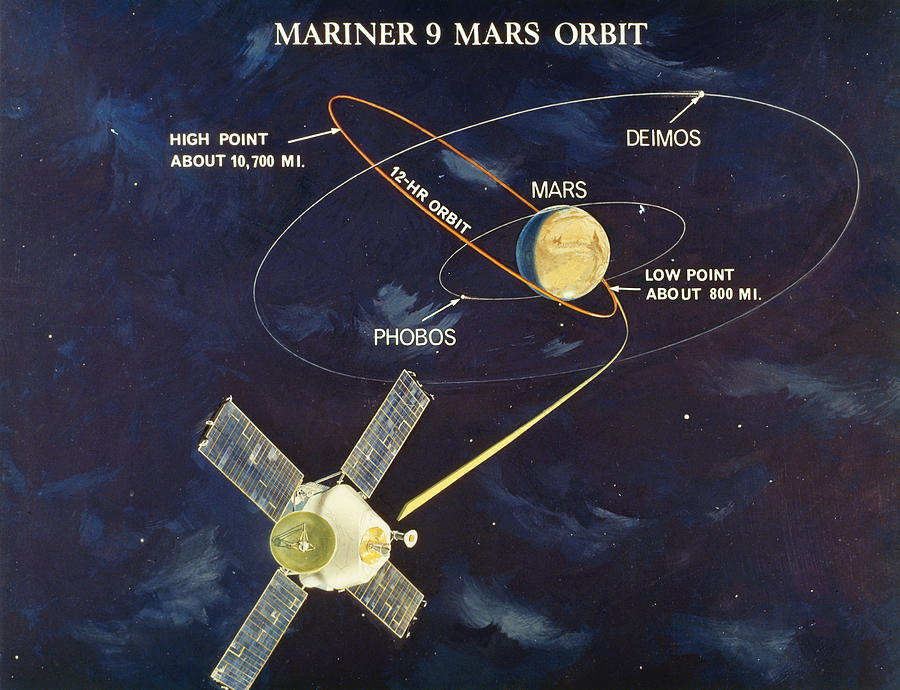
14 November 1971: The Mariner-I probe (also known as "Mariner 9") arrived at Mars & entered orbit, the first spacecraft to orbit another planet; photographic investigation of the surface was delayed 'til January 1972 due to the discovery of a planetwide dust storm; Mariner 9 took 7,329 photos of 85% of the Martian surface, including the dicovery of the namesake Valles Marineris, until 27 October 1972.Bonus! Space Race Song o' the Day: Mariner-I!
The Aquabats!, "Martian Girl!" from The Fury of The Aquabats! (Space Cadet Captain Thumbs Up!)
Semper exploro.
14 November 1971: The Mariner-I probe (also known as "Mariner 9") arrived at Mars & entered orbit, the first spacecraft to orbit another planet; photographic investigation of the surface was delayed 'til January 1972 due to the discovery of a planetwide dust storm; Mariner 9 took 7,329 photos of 85% of the Martian surface, including the dicovery of the namesake Valles Marineris, until 27 October 1972.Bonus! Space Race Song o' the Day: Mariner-I!
The Aquabats!, "Martian Girl!" from The Fury of The Aquabats! (Space Cadet Captain Thumbs Up!)
Semper exploro.
Sunday, May 30, 2021
The Explorers' Club, № DCCCXX
Operation AXIOM: The Space Race—The 50th Anniversary of Mariner-Mars '71, Part II
30 May 1971: The Mariner-I probe (also known as "Mariner 9") lifted off from Florida's Cape Kennedy Air Force Station atop an Atlas-Centaur rocket; Mariner-I was identical to the destroyed Mariner-H probe & carried both ultraviolent & infrared spectrometers, an infrared radiometer, other sensors, & a visual camera vastly improved from the flyby Mariner-Mars 69A & 69B probes (Mariners 6 & 7).Commentary: Mariner-I was now in a race with the Soviet Mars 2 & Mars 3 duo to be the first probe from Earth to orbit another planet; earlier interplanetary probes had performed flyby missions, but not orbited. Stay tuned: the trio arrived at the Red Planet in November 1971.
Bonus! Song o' the Day: Mariner-I
The Skatalites, "Trip to Mars" from Greetings from Skamania (Space Cadet Mike Papa Whiskey)
Semper exploro.
30 May 1971: The Mariner-I probe (also known as "Mariner 9") lifted off from Florida's Cape Kennedy Air Force Station atop an Atlas-Centaur rocket; Mariner-I was identical to the destroyed Mariner-H probe & carried both ultraviolent & infrared spectrometers, an infrared radiometer, other sensors, & a visual camera vastly improved from the flyby Mariner-Mars 69A & 69B probes (Mariners 6 & 7).Commentary: Mariner-I was now in a race with the Soviet Mars 2 & Mars 3 duo to be the first probe from Earth to orbit another planet; earlier interplanetary probes had performed flyby missions, but not orbited. Stay tuned: the trio arrived at the Red Planet in November 1971.
Bonus! Song o' the Day: Mariner-I
The Skatalites, "Trip to Mars" from Greetings from Skamania (Space Cadet Mike Papa Whiskey)
Semper exploro.
Sunday, May 9, 2021
The Explorers' Club, № DCCCXV
Operation AXIOM: The Space Race—The 50th Anniversary of Mariner-Mars '71, Part I
9 May 1971: The Mariner-H probe (also known as "Mariner 8") lifted off from Florida's Cape Kennedy Air Force Station atop an Atlas-Centaur rocket; shortly after staging, the Centaur upper stage began to tumble out of control, both the rocket & the probe crashing into the Atlantic Ocean north of Puerto Rico; the cause of the failure was eventually traced to a malfunction in the guidance system.Commentary: Just as the summer of 2020 saw the launch of three robotic missions to Mars—by the United States of America (Mars 2020, Perseverance rover & Ingenuity helicopter), the People's Republic of China (Tianwen-1, Zhurong rover), & the United Arab Emirates (Emirates Mars Mission, Hope orbiter)—so too the May 1971 Mars launch window saw a flurry of activity from the United States & the Union of Soviet Socialist Republics, as we shall explore in the weeks ahead.
Bonus! Song o' the Day: Mariner-H
Aqua, "Back from Mars" from Aquarius (Space Cadet Mike Papa Whiskey)
Semper exploro.
9 May 1971: The Mariner-H probe (also known as "Mariner 8") lifted off from Florida's Cape Kennedy Air Force Station atop an Atlas-Centaur rocket; shortly after staging, the Centaur upper stage began to tumble out of control, both the rocket & the probe crashing into the Atlantic Ocean north of Puerto Rico; the cause of the failure was eventually traced to a malfunction in the guidance system.Commentary: Just as the summer of 2020 saw the launch of three robotic missions to Mars—by the United States of America (Mars 2020, Perseverance rover & Ingenuity helicopter), the People's Republic of China (Tianwen-1, Zhurong rover), & the United Arab Emirates (Emirates Mars Mission, Hope orbiter)—so too the May 1971 Mars launch window saw a flurry of activity from the United States & the Union of Soviet Socialist Republics, as we shall explore in the weeks ahead.
Bonus! Song o' the Day: Mariner-H
Aqua, "Back from Mars" from Aquarius (Space Cadet Mike Papa Whiskey)
Semper exploro.
Subscribe to:
Posts (Atom)


